Outstanding high-tech turns Brabant’s agriculture and food industry into a top agrifood sector
Cohesion
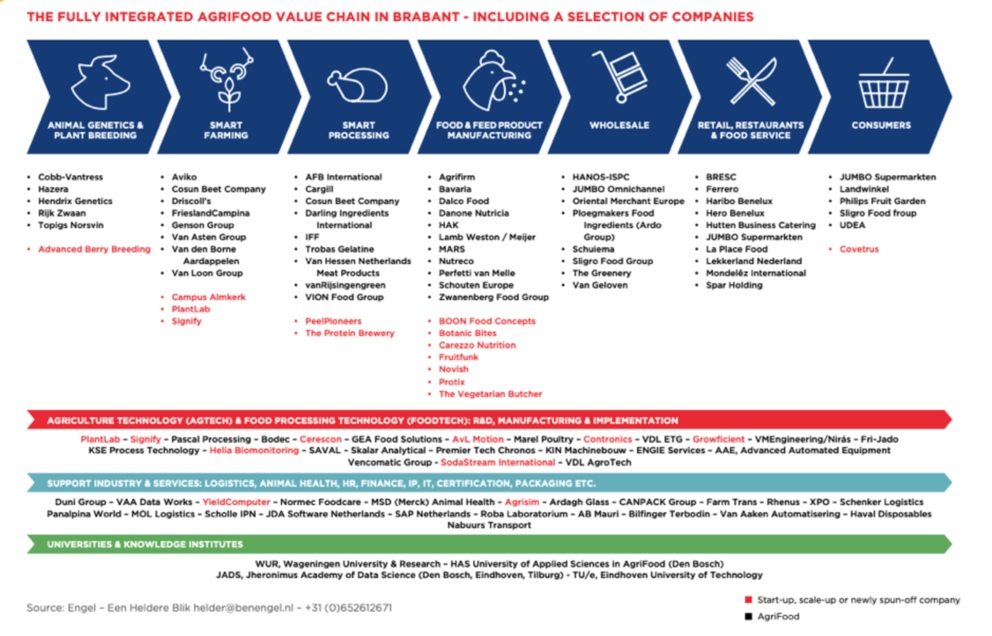
The figures underpin the success story, according to the recently published overview report “Agrifood Sector: an in-depth overview of the agrifood sector in Brabant” by the Brabantse Ontwikkelings Maatschappij (BOM). On a global level, only the United States shows higher figures in agricultural export; within the Netherlands, Brabant is setting an example with 14,000 different companies and together more than 80,000 jobs. And these are only the representatives of the traditional agricultural sector – many of the closely related food technology and agrotech businesses still have to be added to this.
For Sandra van den Poll, BOM’s Project Manager for Foreign Investments with a focus on agrifood, this is also the biggest ‘eye-opener’ of the research. “Of course we already knew that the high-tech sector in Brabant is now very much interwoven with the entire agriculture and livestock sector, but that is precisely why it is good to have hard evidence for this. What’s more, we have now got a much better picture of the strong cohesion.”
The BOM study looked not only at companies that are registered as agrifood companies, but also at the adjacent high-tech activities, such as companies that develop sensors, software, machinery, and processing technology for the food value chain. The BOM study shows that agrifood and high-tech in the regions of Brabant are cooperating intensively and are working hard on the solutions for global sustainable food production. “Our screening of more than 1,600 high-tech companies in Brabant with more than 10 employees shows that more than 30% of these companies are active in the agrifood sector”, according to the researchers. Their activities range from barn construction, air purification, climate control to greenhouse automation, agricultural machinery, and handling systems for sorting and packaging the harvest. And that’s no surprise because all these activities fall within a high-tech sector that accounts for 30% of all industrial R&D in the Netherlands, and 50% of all Dutch patent applications. It’s not for nothing that Brabant ranks fifth in Europe’s index of most innovative regions.
Sustainable development and exploitation of food production in Brabant come both from established companies and disruptive start-ups. Striking examples are The Protein Brewery (new vegetable proteins), Contronics
(that can keep food fresh for longer), Carezzo Nutrition (protein-enriched foods) Signify and Plantlab
(indoor farming), or ByFlow (3D food printers). The sum total of all these activities within the agrifood sector makes it clear that the entire value chain is well developed in the region. This also applies to support services and relevant knowledge institutions, which further strengthen the sector’s robustness.
Opportunities for Brabant
According to Van den Poll, all these examples show how strong the province is in agritech and in the major transition taking place around proteins. “I emphatically see both developments in relation to the resolution of the major issues currently facing the agricultural sector. Innovation can help resolve the tensions that we now regularly see bubbling up.”
All this together puts Brabant in a special position. “Precisely because Brabant is a densely populated conurbation with high demands from the agrifood sector on the living environment, there is also high pressure here to develop smart solutions with minimal impact on people, animals, and the environment”, Van den Poll notes. “And because these problems are increasingly occurring elsewhere in the world, this creates opportunities to use the high level of knowledge that we have. Including the export opportunities for agritech and foodtech in Brabant.”
It is, therefore, logical that the BOM has various programs and projects for the development of business models around protein transition, smart farming, efficient use of raw materials, and reduction of food waste. In addition to these new niches, the report also mentions ‘development areas’ around promising themes such as agro-robotization, alternative proteins, data science in agrifood, and innovative cultivation technologies.
For Sandra van den Poll, the niches around agritech and the protein transition will receive full attention in the coming period, but she also focuses on these development areas. “There is a lot of innovative technology there that has potential solutions to offer. So we are certainly also going to look into the opportunities around these development areas, for example by supporting companies that are active in some of the sub-areas. By establishing themselves in Brabant, they will be able to participate optimally in our ecosystem. Thanks to this report, I can very easily show why they should want this, what exactly is the added value for them. For example, I’m now working on a pitch for a company that I’m sure would be very happy to set up in Brabant. By pointing this out to them, we can help such a company, but at the same time further strengthen our ecosystem.”
BRABANT HAS NINE AGRIFOOD CLUSTERS, CAMPUSES, AND OTHER FORMS OF COOPERATION:
- Food Tech Brainport, Helmond
- GrowWise Research Center by Signify, Eindhoven
- Precision Ag(riculture) Center South, Reusel
- Green Chemistry Campus, Bergen op Zoom
- Nieuw Prinsenland (Agrofood Cluster), Dinteloord
- Green Protein Excellence Center, West Brabant
- Agri & Food Plaza, Den Bosch
- The Jam Factory, Den Bosch
- Delta Agrifood Business, Bergen op Zoom
Download the entire Agrifood study here!