A Brabant factory turning waste into value
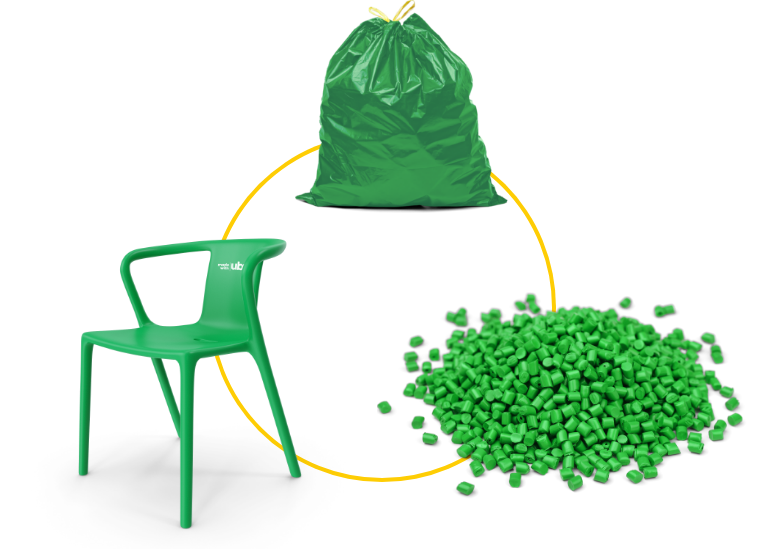
This Brabant-based factory transforms household waste into valuable raw materials with support from the European Union
Surviving in the waste‑recycling industry takes perseverance. Collection is complex and costly, many materials are difficult to recycle, and you’re competing with cheap primary raw materials. Despite these challenges, UBQ Materials has something truly groundbreaking in its hands, says CEO Albert Douer: “I consider myself fortunate to be able to make a real contribution to solving climate challenges.”
When Albert began working in recycling some twenty years ago, he quickly discovered just how difficult it is. “Logistics are expensive, and the technical know-how required is significant,” he explains. “Take plastic waste, for instance: separating it properly and getting it clean enough for recycling is no small task. Another issue is that only a small portion of waste can actually be recycled—everything else ends up in polluting incinerators. At UBQ Materials, we’ve developed a solution to both problems.”
Banana peels and pizza boxes
UBQ Materials found its solution through a revolutionary technology. “With this method, we can recycle up to 95 percent of all household waste,” Albert says. “And that doesn’t just mean plastics—it includes organic waste like pizza boxes, banana peels, and coffee grounds. We convert all of this into a composite material that serves as a sustainable alternative to plastic.”
This composite can be used to create all kinds of products, from automotive parts and office chairs to construction materials and planters. The production process is also highly sustainable: it requires no chemicals, no water, and no high processing temperatures.
In 2024, UBQ Materials received support from the Just Transition Fund (JTF). Albert explains how essential this funding was. “After covid and the war in Ukraine, we had faced some tough financial years. The funding allowed us to build an advanced energy‑monitoring system, which has significantly reduced our energy consumption. It also helped us improve the versatility of our composite, making it easier for customers to integrate into their existing production processes. That’s incredibly important, because I’ve learned that companies want to make sustainable choices, but they sometimes need a little help to get there.”
Rooted in Brabant
The chemical industry in North Brabant, home to UBQ Materials’ factory, is undergoing a major transition. More and more companies are shifting from fossil-based to renewable energy sources. Grants such as those from the JTF help accelerate this shift. “We’re proud to contribute to the region’s renewal,” Albert says. “We feel at home here in Bergen op Zoom. We see this factory as a model for the rest of the world, a demonstration that a large‑scale circular economy is not just possible, but viable. What we learn here can be applied anywhere.”
Albert has spent his life working in industry, but being able to directly contribute to solving climate issues through UBQ gives him deep satisfaction. “I truly feel lucky to have this opportunity. I’m originally from Colombia, and there’s a very poor region there called Chocó, where waste problems are overwhelming. If we could open a UBQ facility there, we wouldn’t just help tackle the waste issue, we’d also create jobs. Their homes could even be built with UBQ‑based construction materials. That’s a dream I would love to bring to life.”
“We’re proud to help renew the region, and we see our factory in Bergen op Zoom as a model for the rest of the world, proof that a large‑scale circular economy is possible.”
Albert Douer, CEO UBQ Materials
A Just and inclusive energy transition
The Just Transition Fund (JTF) is a European program designed to support the transition to a climate‑neutral economy. It ensures that regions reliant on fossil‑fuel‑based industries can move toward renewable energy in a fair, balanced way—one that considers social, economic, and environmental impacts.
Helping international companies land in Brabant
The Brabant Development Agency (BOM) supports international companies as they establish and grow their operations in Brabant. With expertise in internationalization, market entry, and regional networks, BOM helps companies build and scale their European activities from this region.
UBQ Materials received BOM’s support during its arrival in Brabant. By connecting UBQ to the local ecosystem and relevant partners, BOM laid a strong foundation for its establishment in Bergen op Zoom. In doing so, BOM helps attract innovative companies that combine economic growth with solutions to major societal challenges—such as advancing the circular and energy transitions.